segunda-feira, 17 de março de 2014

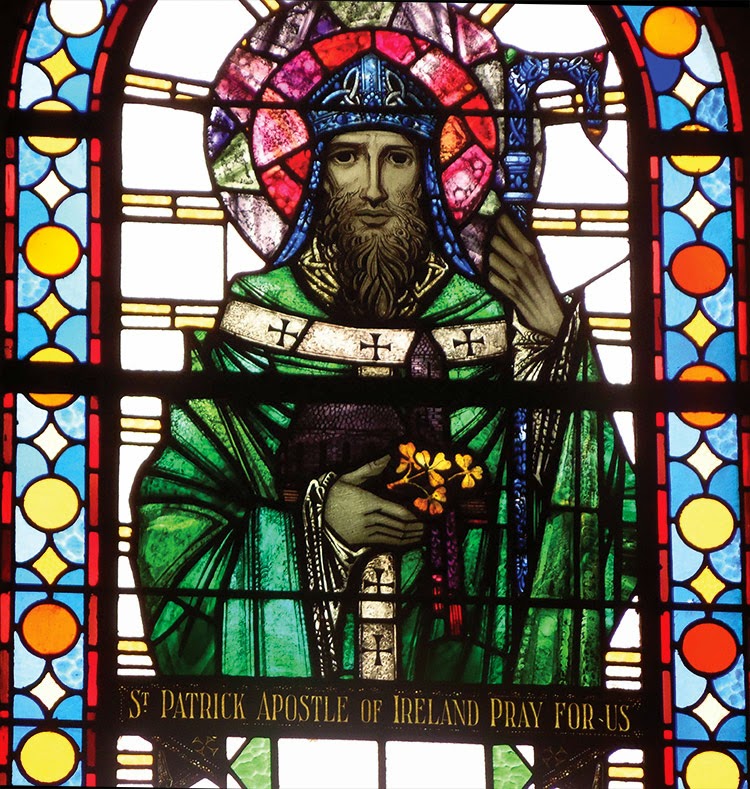
St. Patrick's Day - no...now it's the whole week!


Saint Patrick is the patron saint of Ireland and he is credited with bringing Christianity to Ireland. Because of his connection to the Emerald Island, Saint Patrick’s Day has come to be associated with everything Irish: the color green, pots of gold, shamrocks, leprechauns, beer and luck. Some celebrations has become an icon, such as the dyeing of the Chicago River, which has been done since 1962. Although we also have our patron saint, Our Lady of Aparecida (celebrated on October 12th) and the Irish immigrant community here is not exactly an expressive one (comparing to Italian, Japanese and German imigrants), even we, here in Brazil, have been celebrating the Irish patron lately. However, what really caught my attention is the fact that this celebration is increasing over the years. During the last decade, St. Patrick’s celebration is getting meaningful (we can hear our priests talking about it, as father Marcelo Rossi has done in his radio program) and bigger (in 2014, instead of St. Patrick’s day, there will be a St. Patrick week festival).  Three years ago, we need to go to São Paulo to participate in any kind of celebration related to St. Patrick. Nowadays even our city pub has offered some good promotions and a special menu for this whole week. We know that the beer companies are sponsored the celebration and probably that is the reason it has become more popular over the years, but it’s very nice to have the opportunity of getting together with our friends and having some fun in an authentic Irish style.
Cheers and May the lucky of the Irish be yours!
 
 
Post Question: Have you ever celebrated St. Patrick's Day? How did you celebrate that? How would you like to celebrate it? Where would you like to celebrate it?

Tip: To get more information about St. Patrick's Week in São Paulo, just click here and to learn more about St. Patrick, see the History website.

sexta-feira, 14 de março de 2014

Where Wild Things Are - audiobook to 1ºEM

Where Wild Things Are

 
As we have talked in our class, for the students who would like to train their pronunciation and listening, here you are! The audiobook is really practical and very interesting!
By the way, do you know where the wild things are?
As I wrote in a previous post (June, 2013), this book was published, for the first time, in 1963 and after all these years, it has been one of the reading icon in the American childhood literature. I like it a lot and I do enjoy using it in my classes. And what really get me surprised is that no matter the age, most of my students have a great time reading it. I believe it happens for two main reasons:     
- it is a very simple story, easy to read and easy to get involved. 
- the book describe the world of children's imagination. It's the story of a little boy who is messing around and get punished. He is forced to go to his room and while he is there, he starts to imagine stories, fantasizing about being in a forest and traveling to a place where the monsters live, facing various adventures.
Students identify themselves with the book because all of us were children before and there is still a "little child" inside each one, so they know exactly what is happening with the boy because they did and have done the same thing ... dreamed, imagined and created many stories. It is a sweet memory that comes back and reminds us how fun life can be, even though we are "grounded".
So...Where are the wild things? Thanks to Sendak, we know that they are wherever our imagination would like them to be and the best part...just waiting for our visit!
 
Post Question for the students: In your opinion, Where are the wild things? Although you are in High School, do you still read children's book? How often? Which one is your favorite? Why?
Tip: To read more about Sendak's work and see the Doodle created by Google about his work, just click here. 
 

quarta-feira, 12 de março de 2014

Literature and English all together!

                High school students had their first combines test - Literature and English together! Although people would think of it as just one topic, in our case, it is not. Literature and English are two different subjects, but after some meetings and talk with Ingrid (Literature teacher), we joined the concepts learned in both classes to create just one evaluation instrument. Students have English classes (as a foreign language) and Literature focused on Brazil and Portugal. If we were lucky enough to have the privilege of studying English literature, then the test could be based in just one subject. Unfortunately, we barely have time to explore the English Language, so there are no possibilities of getting into American or British literature as it should be done. The idea of creating this test was exactly the integration, because learning is not a separated process as we usually see in the schools. Sometimes the disconnection among the subjects may create damages beyond repair. Life is integrated and so it is the learning process. Now, the most important point is to hear the students’ opinion, and together with the Literature teacher, Ingrid, we must analyse what could be done to improve the process and make it better for both, teachers and students.
 
Post Question for the students: What's your opinion about the test? How did you like it? What was the difficulty level of the test? Write an interesting and uninteresting point of your test. 
Tip: This website has a brief list of some key terms used in Literature. It may be very helpful! And to learn more about English Literature with a list of books, relevant information  and great videos about them, just click here and have fun.


quinta-feira, 30 de janeiro de 2014

Word Power - Do you have it?

Can what you speak influence your life and who you are?
If we take this sentence into consideration, we can clearly state that your vocabulary can predict your success. In other words, the size of your vocabulary will usually determine the size of your bank account. Word power can be also associated to life power, the power of seduction and we can't deny...it's a great and important power! The famous author of the popular book serie Rich Dad, Poor Dad, Robert Kiyosaki wrote, “If you want to be rich, you have to have a rich man’s vocabulary. Words can make you rich, or can make you poor.” E. D. Hirsch, Jr., is the founder of the Core Knowledge Foundation and professor emeritus of education and humanities at the University of Virginia. He is the author of several acclaimed books on education issues and he has also written in a recent article entitled A Wealth of Words, “the key to increasing upward mobility is expanding vocabulary.”  In the same article, he also states that "Vocabulary doesn’t just help children do well on verbal exams. Studies have solidly established the correlation between vocabulary and real-world ability." This topic is really a very important matter.
According to E. D. Hirsch Jr., "Nonetheless, there’s no better index to accumulated knowledge and general competence than the size of a person’s vocabulary. Simply put: knowing more words makes you smarter. And between 1962 and the present, a big segment of the American population began knowing fewer words, getting less smart, and becoming demonstrably less able to earn a high income." So, if you want to be smarter, you should read, study and dedicate part of your time to improve your vocabulary. And if you want to get a good salary, keep on reading and studying. Now you know that it can bring much more benefits than what you could imagine! 

Post Question for the students: How is your vocabulary? What could you do to improve it? Do you think that it is important to learn new words? What new word have you learned lately?
Tip: To know more about it, just click here and read a complete article about vocabulary, written by E. D. Hirsch Jr. 

segunda-feira, 27 de janeiro de 2014

Parent and Teacher Conference

 
          This post is to thank all the parents that attended the first Parent and Teacher Conference on January 25.
          Although it was on a Saturday morning and we know how the weekend is very special to rest, mainly after a working week, this meeting is a very important moment because it will introduce the school and teacher’s methodology to new parents and explain the changes or some new topic for the ones who have already been with us.
          My students will start the high school period, so it is a great opportunity for parents to meet the new teachers and ask questions about this new phase in their children’s life. Questions like:
      -        What skills and knowledge will the students be expected to master this year?
      -        Are there challenging academic standards and how the students will be informed about the academic standards they are expected to meet?
      -        What kinds of projects and assignments have we planned that will help the students meet higher academic standards?
      -        How will the students be evaluated? How are grades determined in our classroom?
      -        Are summer school, tutoring, or other programs available for students who need more help?
And a very important contribution:
      -        What can parents do to stay more involved in their child's academic progress?
Educate a child, a teenager or an adult is a great responsibility, which must be divided by everyone involved in this process. When the work can be done together, it is easy to achieve the desired results and even go further!
Thank you very much for attending the conference and count on us! 2014 will be a very promising year!
PS.: If any parent couldn’t attend the meeting scheduled by the school, don’t worry. Set up an appointment and I’ll be glad to talk to you! See you!